


AI Knows the Comps, It Doesn’t Know the Property
Artificial intelligence has become remarkably useful in many areas of our lives, and real estate is no exception. At the click of a button, modern algorithms can assemble vast data sets, instantly spot comparable sales, calculate price-per-square-foot ranges, and summarize complex market trends in seconds. Platforms such as Zillow, Redfin, and Realtor.com rely on these automated valuation models (AVMs) to serve up instant price estimates for virtually any address in the country.
For property owners deciding where to anchor a list price—or buyers trying to gauge a sensible opening offer—an AI-generated estimate offers a fast, accessible starting point. However, in high-stakes coastal real estate markets like Pacific Palisades, trusting an algorithm as the final word can prove to be an extraordinarily expensive mistake.
When hundreds of thousands (or even millions) of dollars hinge on getting the price right, relying solely on automated outputs creates a false sense of security. The fundamental problem is simple: real estate is not a standardized commodity. Two homes of identical square footage located only three doors apart can command drastically different valuations for reasons that never show up in the spreadsheets an algorithm processes.
The Invisible Variables: Condition, Views, and Terrain
Computer algorithms excel at analyzing structured data—like bedrooms, bathrooms, square footage, and year built—because those metrics fit neatly into standardized fields. What algorithms continuously struggle to evaluate are the physical, subjective, and environmental variables that directly dictate what a buyer will actually pay.
Consider property condition. Public records may show two neighboring homes as having the exact same footprint, built in the same decade. Yet one may feature a down-to-the-studs architectural remodel with custom finishes, while the other needs substantial structural remediation and deferred maintenance. Even when listing descriptions explicitly mention renovations, a machine cannot independently assess the build quality, aesthetic appeal, or functional layout of those updates.
Views and topography illustrate the exact same blind spot:
- View Quality and Elevation: A computer algorithm can recognize that two homes sit in a hillside neighborhood known for ocean vistas. What it cannot calculate is that one home enjoys an unobstructed, 180-degree ocean panorama, while the property next door has its view completely blocked by mature trees, power lines, or a neighbor’s newly constructed second story.
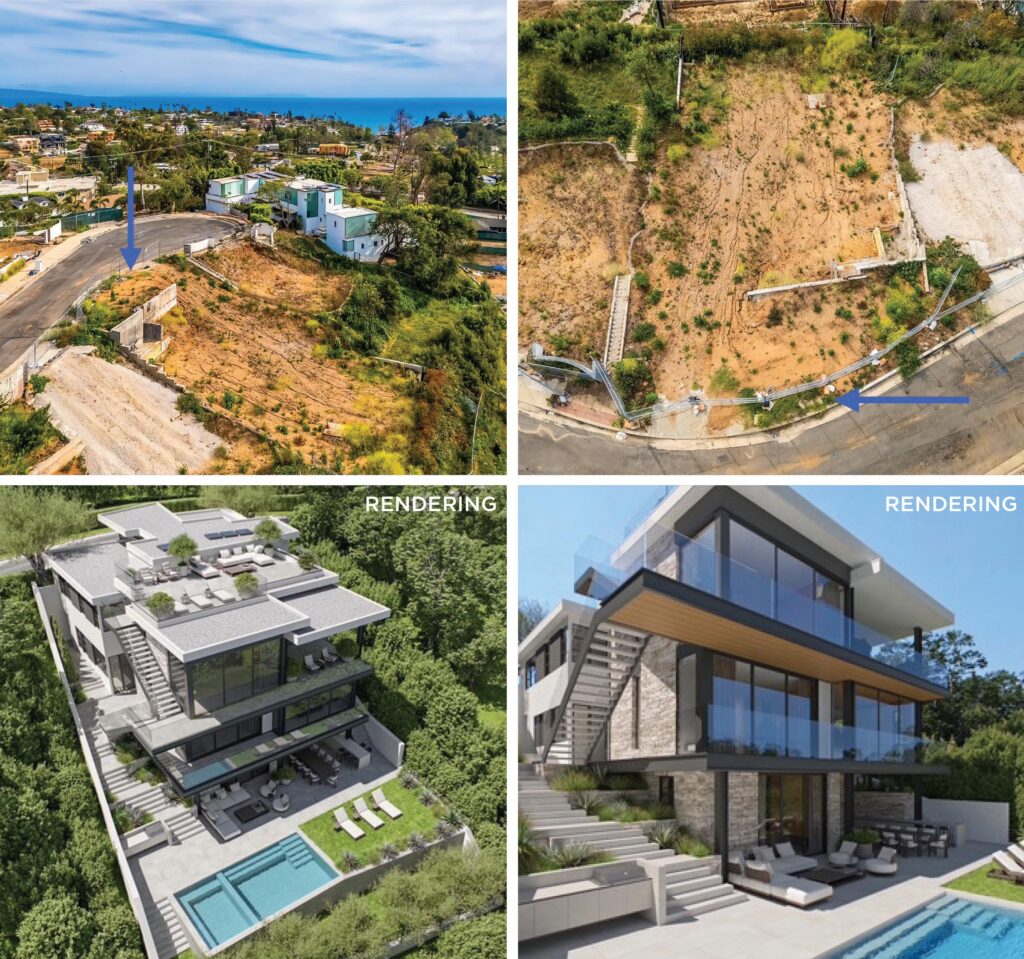
- Usable Land and Topography: Land value presents even greater complexity. Two adjacent 8,000-square-foot parcels are rarely identical. One might feature a pristine, flat pad where 100% of the lot is buildable. The other may sit on a steep slope requiring complex caissons, retaining walls, and specialized engineering, leaving only a fraction of the site realistically usable.
- Micro-Location Dynamics: Dozens of subtle localized details influence value without ever triggering a data flag. Factors like lot orientation, natural light exposure, street noise, proximity to busy intersections, architectural character, and internal floor plan flow heavily impact buyer sentiment. Similarly, legal constraints like utility easements, setback lines, deed restrictions, and zoning limits dictate maximum buildable square footage in ways standard algorithms fail to synthesize.
The Post-Fire Data Trap in Pacific Palisades
In today’s Pacific Palisades real estate environment, automated algorithms face an even more dangerous hurdle: flawed baseline data. Following major regional events, public record systems frequently lag behind physical reality.
A recent property sale may enter a public database flagged as the transfer of a single-family or multi-family residence simply because that was how the parcel was historically classified in County records. In reality, the structure may have been destroyed, meaning the transaction was purely a land sale. If an AI valuation model ingests that price tag and treats it as a fully built, turn-key home comp, every valuation downstream becomes fundamentally flawed and wildly misleading.
Beyond misclassified land sales, public databases regularly miss critical hyper-local realities, including:
- Unpermitted square footage and undocumented additions.
- Specialized insurance hurdles or hyper-local fire risk scores.
- Sub-surface soil stability, drainage issues, or coastal bluff regulations.
- Active neighborhood construction projects causing temporary access or parking friction.
- Subtle boundaries between micro-neighborhoods that local buyers weigh heavily.
There is also a conversational AI problem that many users overlook: prompt bias. Large language models (LLMs) are inherently designed to mirror the framing of the prompt they are given. Ask a chatbot, “How much should I pay for this property?” and it will structure its reasoning around establishing a fair purchase price. Ask the exact same system, “Is $2 million enough for my property?” and it will actively search for arguments to justify that $2 million benchmark. Small variations in word choice, user assumptions, or which specific comp links you provide can lead conversational AI to vastly different conclusions.
Balancing Data Intelligence with Market Judgment
Acknowledging these limitations does not mean artificial intelligence has no place in modern real estate. Used correctly, AI serves as an exceptional research assistant. It can rapidly parse massive sales databases, spot broad historic patterns, perform complex baseline mathematical adjustments, and prompt buyers and sellers to ask questions they might not have otherwise considered.
Yet, for all its processing power, AI cannot walk through a front door.
It does not stand in a backyard to measure the hum of street traffic. It cannot see how much horizon disappears when a neighbor expands their roofline. It cannot feel the subtle shift in street appeal between one block and the next. Most importantly, an algorithm never sits across the closing table from active buyers to hear precisely what made them write a full-price offer—or walk away entirely.
The danger arises when an automated estimate that looks mathematically precise is mistaken for one that is genuinely accurate. Real estate valuation has always relied on two distinct pillars: comprehensive data and experienced human judgment. AI can undoubtedly accelerate the first, but local observation and transactional experience remain essential to the second.
Sellers and buyers navigate the market best when they treat AI as a helpful introductory research tool—never as the final authority on what a specific property is worth.